Introduction
This animated educational campaign was produced for a European government with a clear objective: help families navigate children’s mobile use through structured, practical guidance.
The initiative focused on digital wellbeing, screen-time awareness, online privacy, and responsible device habits. Rather than delivering abstract warnings, the campaign translated policy-level digital responsibility into relatable family scenarios.
As an explainer video and animated educational campaign, the project required more than visual storytelling. It demanded clarity, sensitivity, and a production workflow capable of handling cross-platform distribution at national scale.
Defining the Educational Framework Before Animation
In digital awareness campaign production, the risk is either sounding overly technical or overly moralising. For a government-backed initiative, tone matters as much as accuracy.
The first phase focused on mapping the communication structure:
Who is the primary listener, the parent or the child?
What behavioural shift is expected?
Which digital risks require simplification without distortion?
How do we balance authority with warmth?
Workshops with the commissioning body clarified five core themes: supervised mobile use, screen-time balance, privacy awareness, digital footprint understanding, and constructive family dialogue.
Each short film in the series was structured around one theme, one scenario, and one clear takeaway. The goal was guidance, not fear.
Building a Cohesive Animated Educational Series
The campaign consisted of five short animated films, a master edit, and multiple social adaptations. Each episode followed a different family member’s perspective, ensuring both parents and children felt represented.
From a storytelling standpoint, the series used:
clear narrative arcs
grounded, everyday situations
direct but non-didactic dialogue
visual metaphors to simplify technical topics
The scripts were written to function equally well on television and on mobile feeds. Every line had to survive both environments.
In educational explainer video production, brevity is not simplification — it is precision.
3D Character Pipeline and Motion System Design
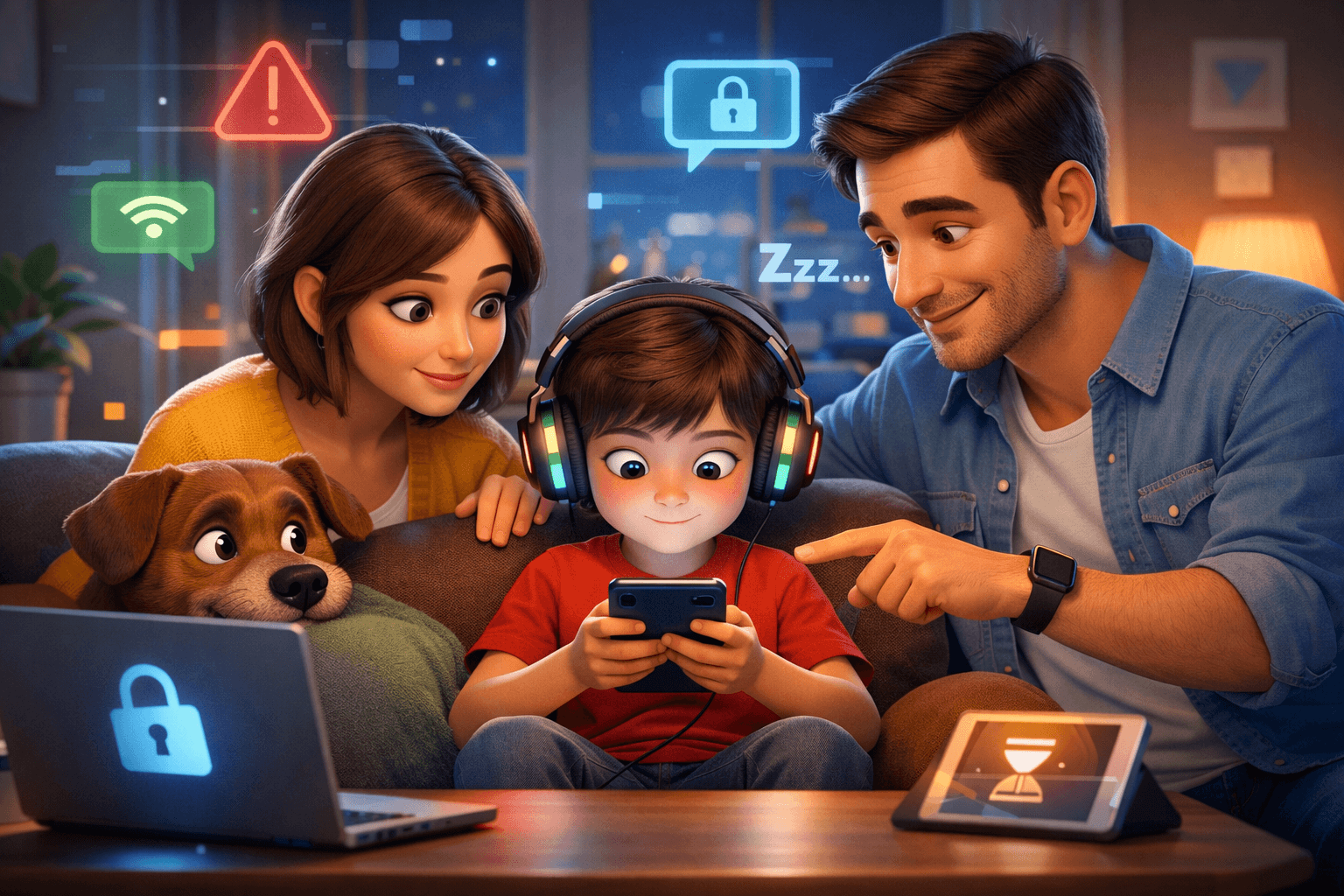
Visually, the campaign combined a stylised 3D character pipeline with clean motion graphics overlays representing notifications, chat bubbles, and digital interfaces.
The 3D character workflow included:
character modelling with modular rig systems
simplified but expressive facial animation
lighting setups optimised for both TV and social formats
controlled rendering passes for compositing flexibility
Rather than overwhelming the screen with digital clutter, the motion system was designed to echo real device behaviour in a controlled way. Split screens, push notifications, and UI elements were integrated into the narrative rhythm, reinforcing the message without distracting from it.
Consistency across five films was achieved through shared lighting logic, colour hierarchy, and timing discipline.
Cross-Platform Adaptation and Multi-Format Delivery
Government awareness campaigns require distribution precision. The production pipeline was built from the outset for cross-platform deployment.
Final deliverables included:
16:9 broadcast masters
1:1 square formats for social feeds
9:16 vertical adaptations for mobile platforms
a master compilation film for digital rollout
Each version was re-timed and re-framed to preserve readability. Educational messaging must remain legible even when viewed without sound or on small screens.
A structured multi-format delivery workflow ensured visual continuity across all channels while maintaining technical compliance with broadcast standards.
Sound Design and Educational Clarity
Sound played a strategic role in reinforcing clarity.
Voice direction prioritised warmth and credibility over theatrical performance. Subtle sound design — notification pings, typing sounds, environmental ambience — added realism without creating anxiety.
Music selection leaned toward grounded, reassuring tones. The objective was to create an atmosphere where families felt invited into the conversation rather than warned into compliance.
In animated educational campaign production, sound often determines whether content feels supportive or instructive.
Results and Impact
The campaign successfully translated complex digital safety principles into accessible family conversations.
As a European awareness campaign, it achieved:
strong cross-generational engagement
positive feedback on tone and relatability
internal recognition for balancing authority with empathy
More importantly, it demonstrated how explainer video production can function as public communication infrastructure. When built carefully, animated content can support policy objectives without losing human connection.
Why Digital Awareness Campaign Production Requires Structure
Producing an animated educational campaign for a European government involves more than animation craft.
It requires:
strategic message architecture
sensitivity to behavioural guidance
scalable design systems
cross-platform production readiness
disciplined post-production workflow
Educational content cannot rely on spectacle. It relies on clarity.
This project illustrates how explainer video production, when grounded in structure and thoughtful design, can bridge the gap between policy and everyday life.
And occasionally, even serious topics benefit from a light, human touch — just enough to keep families watching, listening, and talking.